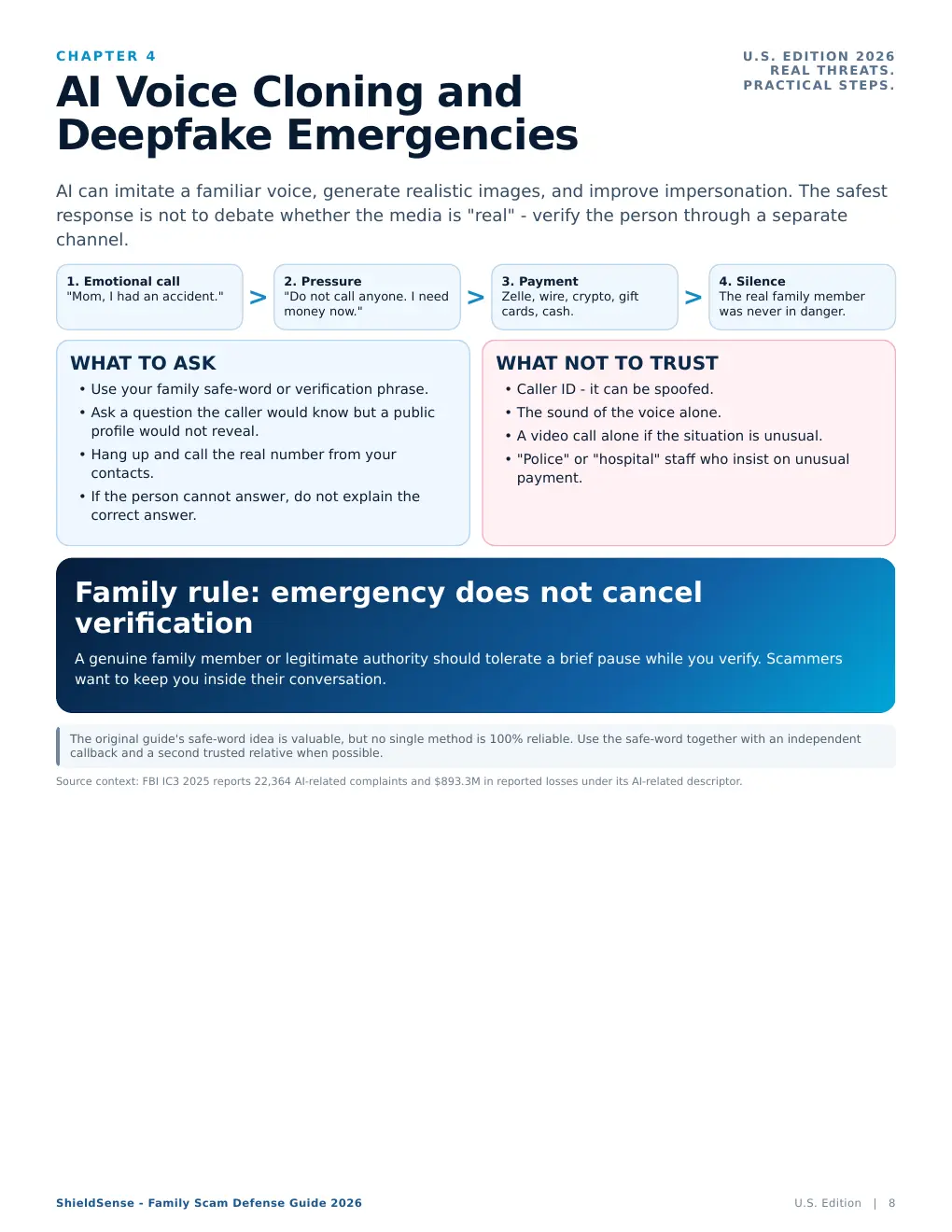
Protect your family from voice-cloning scams by agreeing on a private safe word, ending unexpected emergency calls, and calling the relative back on a number you already trust. Treat urgency, secrecy and unusual payment demands as reasons to pause—not as proof the emergency is real.
01
Why a familiar voice is no longer proof
A short public audio clip can help a criminal imitate how someone sounds. The call may also use personal details gathered from social profiles, leaked data or earlier conversations.
The safest habit is to verify identity through a second channel. A convincing voice, caller ID or detailed family story should never replace that step.
02
Build a five-step family verification plan
- 01Stop
Do not transfer money, share a code or confirm personal details during the incoming call.
- 02Ask
Use the private family safe word or ask a question that is not easy to learn online.
- 03Hang up
End the call even when the caller tells you to stay on the line or keep the situation secret.
- 04Call back
Use a saved number for the relative or another trusted family member—not a number supplied by the caller.
- 05Escalate safely
If there may be immediate physical danger, contact emergency services through an independently verified channel.
03
Set the protocol before anyone is frightened
- Choose a safe word that is memorable but not posted online
- Name two backup relatives who can verify an emergency
- Tell children and older relatives that hanging up is allowed
- Agree that legitimate family members will never object to verification
- Review the plan when phone numbers or caregivers change
Frequently asked questions
Questions families ask.
Can scammers really clone a family member’s voice?
Voice-generation tools can produce convincing imitations from limited audio. The quality varies, but families should verify through a trusted second channel rather than judging the voice alone.
What if the caller knows private family details?
Personal details can come from social media, breached accounts or earlier manipulation. End the call and contact the person or a trusted relative using a saved number.
Should our safe word ever be sent by text?
Avoid placing it in ordinary messages or public notes. Share it directly, keep it private and replace it if you think it has been exposed.
This educational guide is checked against official U.S. consumer-protection and cybersecurity guidance. If money, identity information or account access may be at risk, contact the relevant institution through its official app, statement or independently typed website.